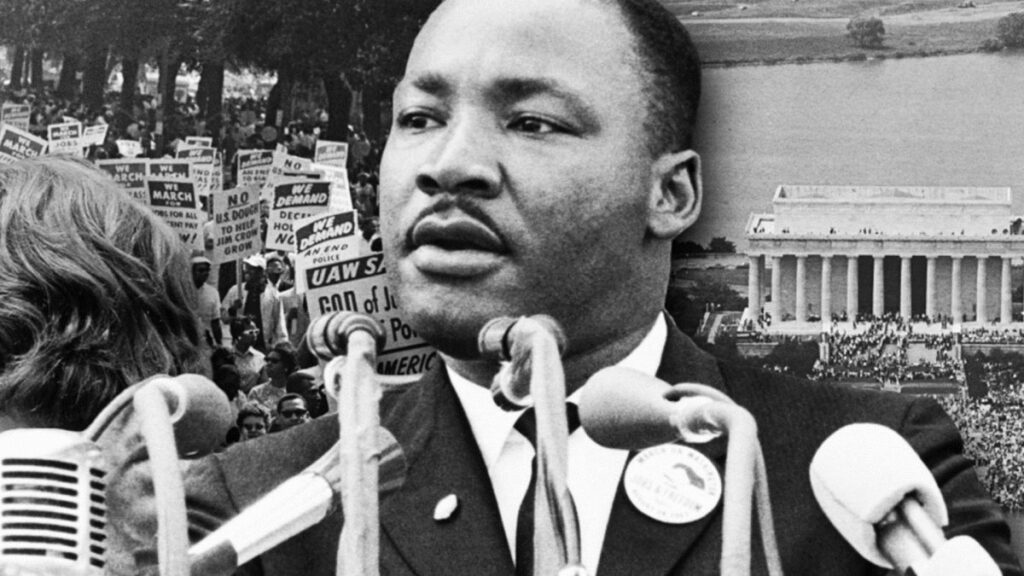

This month, Liberty Project is spotlighting civil rights songs because they’re living soundtracks of endurance and resilience. From marches in the 1960s to protests in 2025, we raise our voices in song because they continue to inspire, unify, and remind us that the fight for justice is ongoing.
Music has always been a powerful force in the quest for equality and justice. It offers balm to the weary; solace for the lonely and lost; inspiration for those intent on changing the world.
The songs of the civil rights era endure because they still speak to us. The Library of Congress notes: freedom songs were never incidental. They were essential tools of solidarity and survival. As long as injustice prevails, these songs will be sung.
1. A Change Is Gonna Come – Sam Cooke
Sam Cooke had painful first-hand knowledge of segregation and attendant evils. Rolling Stone calls it the number-1 protest song of all time. Cooke’s death in 1964 kept him from witnessing the changes he so desperately wished to see take place.
2. We Shall Overcome
Based on a gospel tune, transformed into a freedom chorus at Highlander Folk School. As PBS’s Soundtrack for a Revolution points out, this song’s evolution from the church to the streets shows how adaptable and enduring freedom music can be.
3. Strange Fruit – Billie Holiday
1939’s “Strange Fruit” was a quietly devastating protest against lynching. Songs like this last because, as AP News notes about protest music elaborates, the best anthems capture a moment in history while still resonating across decades.
4. People Get Ready – Curtis Mayfield / The Impressions
Dr. Martin Luther King regarded Curtis Mayfield’s soulful “People Get Ready” as the civil rights movement’s unofficial anthem. Its endurance lies in its hopeful, universal message. Time’s history of “Lift Every Voice and Sing” attributes its longevity to the fact that it is simultaneously a personal meditation and a public declaration.
5. We Who Believe in Freedom Shall Not Rest (Ella’s Song) – Sweet Honey in the Rock
Sweet Honey in the Rock set civil rights activist Ella Baker’s words to music. Its refrain — “We who believe in freedom cannot not rest until it comes” — embodies the endurance of the movement itself. As the Library of Congress explains, music has always played a vital role in providing a home and a platform for voices traditionally locked out of the culture.
6. I Shall Not Be Moved (“We Shall Not Be Moved”)
An African American spiritual turned protest hymn that compares civil rights advocates and their quest for equality to a tree with deep, deep roots, immovable in the face of oppression. This simple but highly effective metaphor explains why, decades later, it is still sung at labor rallies and justice marches.
7. Wade in the Water
Often linked to Harriet Tubman and the Underground Railroad, this spiritual carried double meanings: literal safety by entering water and metaphorical liberation. Its survival through oral tradition illustrates what PBS emphasizes — songs could pass coded messages and offer comfort and courage at the same time.
8. Oh Freedom
The lyrics “Before I’ll be a slave / I’ll be buried in my grave” is both a lament and a rallying cry. According to the Library of Congress the song’s strength lies in its ability to instill deep emotion into a few lines everyone can sing.
9. The Times They Are A-Changin’ – Bob Dylan
Bob Dylan wasn’t central to civil rights organizing, but his folk anthem embodies the vast changes American society would soon undergo. AP News explains how protest songs shifted after the 1960s: less effective in recruiting mainstream culture to help the cause, but still capable of motivating and supporting protest. Dylan’s work remains proof that one songwriter can amplify a movement.
10. Keep Your Eyes on the Prize
Another favorite at mass meetings, this song draws upon gospel traditions but blossomed into a pointed message for activists: never give up. This echoes the Martin Luther King, Jr. Institute’s view that civil rights songs “kept alive a faith, a radiant hope, in the future.”
Why These Songs Endure
These songs live on because they speak to shared experience, collective struggle, and hope. And that moves the movement forward.